LMS
LMS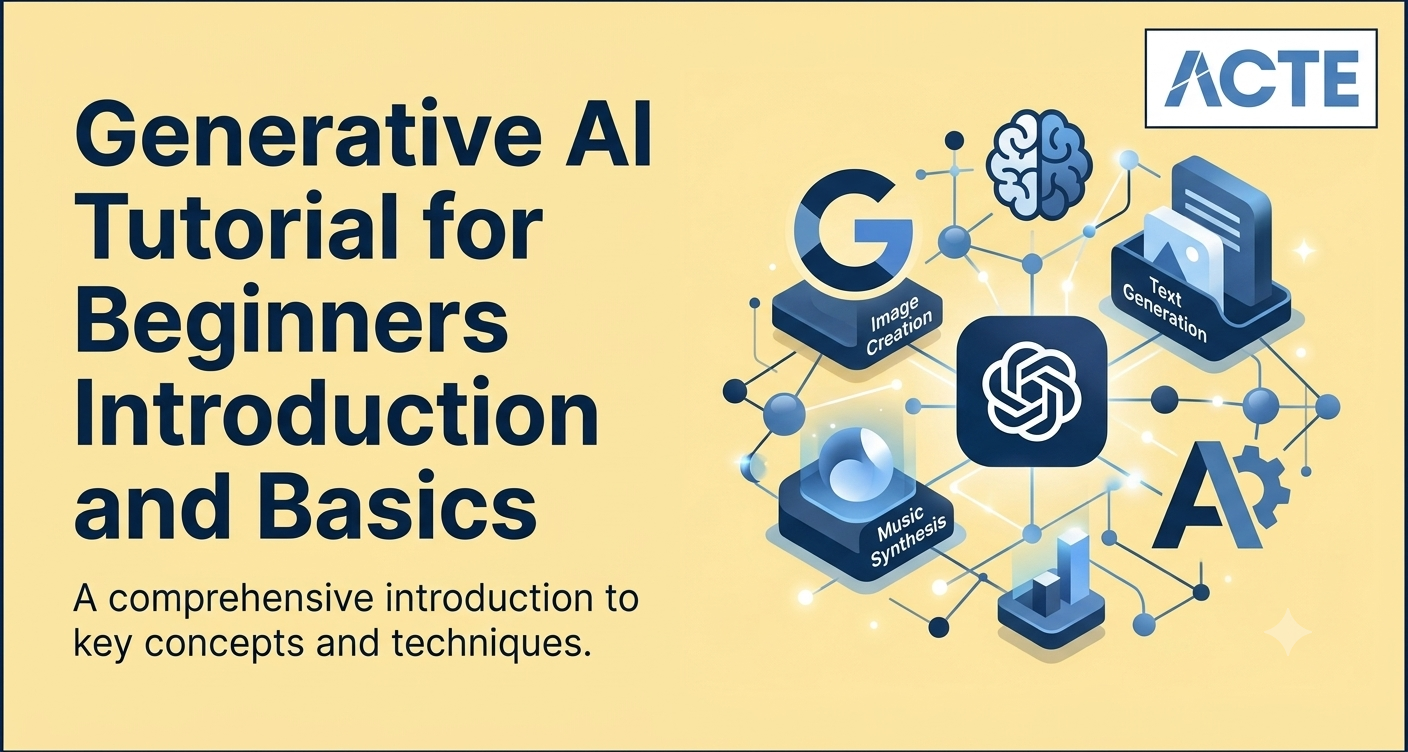
Last updated on 16th May 2026| 4581

- Introduction to Generative AI Tutorial for Beginners
- Foundations of Gen AI
- Neural Networks Basics
- Generative Models Overview
- GANs and Variational Autoencoders
- Transformers Explained
- Applications in Text and Images
- Tools and Platforms
- Ethics and Responsible AI
- Conclusion
Introduction to Generative AI Tutorial for Beginners
Generative AI Tutorial for Beginners is a branch of artificial intelligence focused on creating new content such as text, images, audio, and even code. Unlike traditional AI, which classifies or predicts, generative models learn data distributions and produce outputs that resemble human creativity in Gen AI Course. They rely on deep learning architectures, particularly neural networks, to capture complex relationships in data. For beginners, the appeal lies in seeing machines generate essays, artwork, or music that feels human‑like. Generative AI has become mainstream with models like GPT for text and diffusion models for images. It is widely applied in industries from healthcare to entertainment, automating tasks and sparking innovation. The technology is event‑driven, responding to prompts or inputs to produce dynamic results. Its structured programming concepts make it approachable for learners. Generative AI is not just technical but also philosophical, raising questions about originality and ethics. Learning it provides a gateway into modern AI careers.
Foundations of Generative AI
- Introduction to LLMs: Large Language Models (LLMs) are advanced AI systems that understand, generate, and analyze human language. They are trained on massive text datasets to perform tasks such as content creation, summarization, translation, coding assistance, and question answering.
- Training Process: LLMs learn language patterns through deep learning, transformer architectures, and self-supervised training on large-scale datasets. This process enables models to understand context, predict text, and generate meaningful responses.
- Tokenization and Embeddings: Before processing text, LLMs convert sentences into tokens and numerical embeddings that capture semantic meaning and contextual relationships, enabling accurate language understanding and generation.
- Prompt Engineering: Well-structured prompts help guide LLMs to produce accurate, relevant, and context-aware responses. Learning prompt engineering is essential for maximizing the effectiveness of generative AI applications.
- Fine-Tuning and Customization: Pre-trained language models can be fine-tuned using domain-specific datasets to improve performance for specialized business, healthcare, finance, education, and customer support applications. To gain a deeper understanding, explore the Large Language Model Tutorial.
- Applications and Challenges: LLMs power chatbots, virtual assistants, content generation, code completion, translation, and enterprise automation. Key challenges include model bias, hallucinations, privacy concerns, ethical AI usage, and the computational resources required for training and deployment.
Neural Networks Basics
Neural networks are the backbone of generative AI, inspired by the human brain’s structure. They consist of input, hidden, and passes results forward. Training involves adjusting weights using backpropagation and gradient descent in Gen AI Course. Activation functions like ReLU and sigmoid introduce non‑linearity, enabling complex learning. Neural networks can approximate almost any function, making them powerful for tasks like image recognition and text generation.
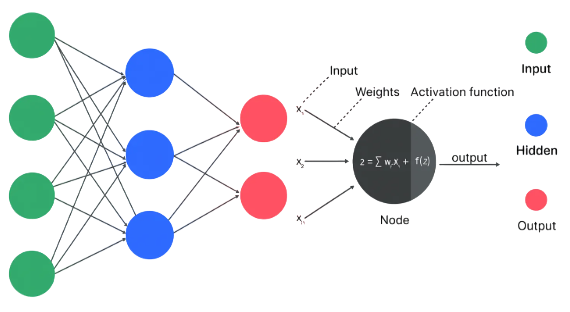
Overfitting and underfitting are common challenges, solved with techniques like dropout and regularization. When multiple layers are stacked, networks become “deep,” forming deep learning systems. These systems learn hierarchical representations directly from raw data. For freshers, mastering neural networks is essential before tackling advanced architectures like CNNs, RNNs, and transformers. They form the foundation of generative models and modern AI applications.
Ready to earn your Gen AI Professional Certification? Discover the Gen AI Course now available at ACTE!
Generative Models Overview
- Types of Models: Variational Autoencoders (VAEs) learn latent representations of data, Generative Adversarial Networks (GANs) generate realistic content through adversarial training, diffusion models create high-quality outputs using a step-by-step denoising process, and transformer models excel at understanding and generating sequential data such as text.
- Applications: Generative models are widely used for text generation, image synthesis, code generation, music creation, video generation, scientific simulations, virtual assistants, and creative content production across multiple industries.
- Key Concepts: Latent spaces, embeddings, probability distributions, attention mechanisms, and optimization algorithms enable generative models to produce context-aware, creative, and high-quality outputs while maintaining accuracy and coherence.
- Benefits for Freshers: Learning generative AI helps beginners build practical AI skills, work on real-world projects, understand modern deep learning techniques, and prepare for careers in artificial intelligence, machine learning, and data science.
- Training Process: Generative models are trained on large datasets to learn meaningful patterns and relationships through continuous optimization. To explore frameworks used for building AI applications, visit the LangChain Tutorial.
- Challenges and Limitations: Generative AI models may encounter challenges such as bias, hallucinations, high computational costs, privacy concerns, and limited explainability. Addressing these issues is essential for developing reliable and responsible AI systems.
Get your Gen AI certification by learning from industry-leading experts and advance your career with ACTE’s Gen AI Course.
GANs and Variational Autoencoders
Generative Adversarial Networks (GANs) and Variational Autoencoders (VAEs) are two cornerstone architectures in generative AI. GANs consist of a generator that creates synthetic data and a discriminator that evaluates authenticity. Through adversarial training, the generator improves until outputs resemble real data. VAEs, by contrast, encode data into latent variables and decode them back into outputs, balancing reconstruction accuracy with regularization. GANs are known for producing highly realistic images, while VAEs excel at structured latent representations and ChatGPT and LLM Tutorials. Both approaches highlight different philosophies: GANs thrive on competition, VAEs on probabilistic modeling. Challenges include mode collapse in GANs and blurry outputs in VAEs. Despite limitations, they are widely used in art, design, and synthetic dataset creation. For freshers, learning GANs and VAEs provides insight into how machines can generate new data. They are stepping stones toward mastering advanced generative systems.

Transformers Explained
- Architecture: Transformer models use encoder and decoder architectures with self-attention mechanisms to understand contextual relationships between words. Positional encoding preserves the order of input sequences, enabling efficient processing of complex language tasks.
- Applications: Transformers power a wide range of AI applications, including machine translation, text summarization, question answering, chatbots, code generation, sentiment analysis, and multimodal systems that process text, images, and audio.
- Advantages: Transformer architectures support parallel processing, improve training efficiency, handle long-context sequences, and scale effectively to large datasets, making them the foundation of modern large language models. To explore another exciting AI domain, visit the Robotics Tutorial.
- Learning Focus: Beginners should understand attention mechanisms, encoder-decoder architectures, GPT and BERT models, tokenization, embeddings, and practical implementation using Hugging Face Transformers to build real-world generative AI applications.

Get JOB Oriented Gen AI Training for Beginners By MNC Experts
- Instructor-led Sessions
- Real-life Case Studies
- Assignments
Applications in Text and Images
Generative AI Tutorial for Beginners has revolutionized applications in text and images. In text, it powers chatbots, content creation, summarization, and translation. Models like GPT can generate essays, code, and stories, making them versatile tools. In images, GANs and diffusion models create realistic art, design prototypes, and synthetic datasets. These applications enhance productivity and creativity across industries and know more in Hugging Face Tutorial . Text generation often involves prompt engineering to guide outputs effectively. Image generation requires understanding latent spaces and training data. Generative AI also supports accessibility, such as creating alt‑text for images. In entertainment, it is used for game design and movie effects. Businesses leverage it for marketing content and product visuals. For freshers, experimenting with text and image generation provides practical experience. These applications demonstrate the real‑world impact of Gen AI and inspire innovation.
Want to Master Gen AI? Explore the Gen AI Master Program Offered at ACTE Today!
Tools and Frameworks
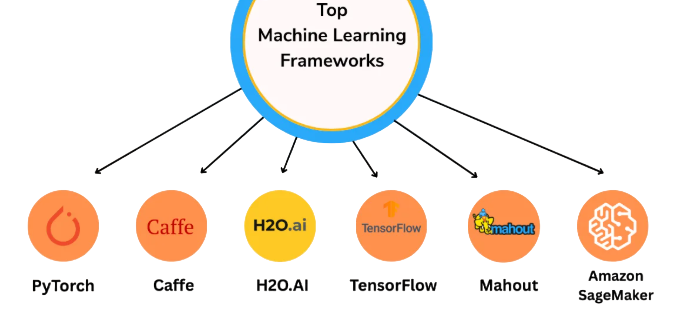
- Frameworks: TensorFlow provides comprehensive support for deep learning applications, PyTorch offers flexibility and performance for research and development, Keras simplifies model creation with an intuitive API, and Hugging Face delivers access to powerful pre-trained AI models and Leran More in AI Content Creation Tools Tutorial.
- Platforms: Google Colab enables free cloud-based coding and experimentation, AWS and Azure provide scalable infrastructure for AI development, Kaggle offers datasets and competitions for hands-on learning, and Jupyter Notebooks support interactive model development.
- Utilities: APIs simplify the integration of AI capabilities into applications, preprocessing libraries help prepare and clean data, visualization tools assist in monitoring model performance, and deployment platforms enable scalable production environments.
- Learning Approach: Begin with Google Colab for practical exercises, use Hugging Face for natural language processing projects, explore PyTorch for building custom models, and gradually transition to cloud platforms for large-scale AI development Expolre more in OpenAI Tools Tutorial.
Ethics and Responsible AI
Ethics is central to generative AI because of its power to create convincing outputs. Bias in training data can lead to unfair or harmful results. Deepfakes highlight risks of misuse, raising concerns about authenticity and trust. Responsible AI emphasizes fairness, transparency, and accountability in Gen AI Course. Developers must ensure outputs are accurate and unbiased. Privacy is another concern, as generative models may inadvertently expose sensitive information. Regulation and guidelines are emerging to govern responsible use. For freshers, learning ethics is as important as technical skills. It prepares them to build AI systems that benefit society. Ethical awareness ensures AI is used for innovation, not harm. Responsible AI practices safeguard both users and industries. Variational Autoencoders section reminds learners that technology must align with human values.
Want to Learn About AI? Explore Our Artificial Intalligence Interview Questions and Answers Featuring the Most Frequently Asked Questions in Job Interviews.
Conclusion
Generative AI Tutorial for Beginners represents one of the most transformative advancements in modern technology, blending creativity with computational intelligence. From its foundations in artificial intelligence and neural networks to specialized models like GANs, VAEs, and transformers, it equips learners with the ability to understand and build systems that generate text, images, and other forms of content. For freshers, this journey begins with mastering the basics, experimenting with tools and platforms, and gradually progressing to real‑world applications in Gen AI Course . Alongside technical skills, awareness of ethics and responsible AI practices ensures that innovation aligns with fairness, transparency, and societal values. The career path in generative AI is vast, ranging from entry‑level roles like AI interns and prompt engineers to advanced positions such as machine learning researchers and applied scientists. Ultimately, generative AI is not just about building models — it is about shaping the future of creativity, productivity, and human‑machine collaboration. By embracing both technical depth and ethical responsibility, freshers can position themselves at the forefront of this exciting and evolving field.